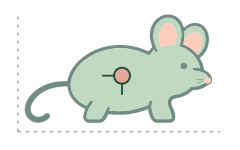
Positions leave out shape
A 2D position can show where an animal is, while leaving out how its body is posed and moving through space.
A clearer view of animal behavior
Changes in the way an animal moves can reveal changes in health and well-being. Behavini is developing AI-assisted 3D body modelling to capture a richer, more useful picture of that movement.
Get in touchBehavior is more than a point on a screen. Shape, appearance, and subtle shifts can tell a deeper story.
The problem
One mouse pose, shown as a schematic position, keypoint map, and body model. These illustrations are not model output.
A 2D position can show where an animal is, while leaving out how its body is posed and moving through space.
Sparse landmarks are useful, but may miss subtle changes in body shape, posture, and motion between tracked points.
Explicit 3D body models could make those changes easier to quantify, compare, and interpret over time.
Our approach
We combine explicit 3D body modelling with AI to work toward movement measurements that researchers can inspect and use.
Where it could help
Encouraged by evidence in the literature, we anticipate substantial advances in these areas through our approach.
Study prodromal and early disease-related changes in animal models through more detailed movement measures.
Measure behavioral effects and explore when meaningful changes begin to emerge.
Generate data to support model training and evaluation across movement scenarios and species.
What we are building
Behavini is in development. These areas describe our design goals across species, based on our findings in monkeys and humans.
Development goalsMore realistic representations of how bodies are shaped, posed, and moving in 3D.
Explainable AI and movement measurements researchers can examine and relate back to behavior.
Adaptation to different species in research and industry through developing species-specific models and synthetic pretraining.
Research
These publications do not constitute validation of Behavini’s technology.
The people
Research experience spanning 3D animal motion and real-world gait measurement.

3D motion & computer vision
Researches computational neuroscience and computer vision, with a focus on 3D pose reconstruction, motion capture, and animal body modelling.
Institutional profile
Digital gait measurement
Studies real-world gait in neurological disease, using movement measurements to examine subtle changes and progression in ataxia.
Institutional profileResearch affiliations
Get in touch
We welcome conversations with research collaborators, pilot partners, and funding partners interested in better tools for animal behavioral analysis.

